Detail from A Courtier and His Lady by Circle of Marcus Gheeraerts (private collection). Photograph taken from a print hung in my living room. I've been going back and forth on this portrait for decades now, but I think I've finally concluded, to my satisfaction at least, who the sitter is. See below post for details.
I
have a print of this portrait hung in my living room and for decades now have been debating whether the shunned courtier in white, posing before a powerful woman with her back turned to him, is Sir Walter
Raleigh or Edward de Vere. I once wrote a blog post arguing it was Raleigh. Then I began to
suspect it was de Vere. And now I've reversed my opinion again and
believe it's Raleigh. But there are still a lot of unanswered questions regarding this portrait.
I recently learned from Stella Samaras, a reader of this blog, that a catalogue available from Weiss Gallery ("Tudor and Stewart Portraits 1530-1600") written by Mark Weiss, with the assistance of Sir Roy Strong, attributed this portrait not to Robert Peake but to the circle of Marcus Gheeraerts the Younger and dates the picture to c. 1590-1595. As to this date, my first reaction was surprised that the wrist ruffles didn't cause Weiss to date the picture to 1584 or earlier since ruffles were replaced by cuffs around then. But we will get to that discussion in a moment.
The catalogue states the portrait was at some point "dramatically overpainted." The courtier was scamped with a head of dark hair, a beard, and a hat "so that he better resembled Sir Walter Raleigh." Stranger yet, the woman in the background so resembling Elizabeth I (with her back turned significantly to the male courtier) was overpainted out of the portrait entirely. And the inscription "Sir. Walt. Rawleigh" was added to the upper right corner.
Note that in the portrait of Raleigh below he has cuffs instead of ruffles. The inscription, if accurate, establishes the portrait was painted in 1588, a few years after wrist ruffles went out of style, so the cuffs fit the inscribed date. As does the bombast stuffing in the bishop sleeves, the giant buttons on the doublet, and the Armada perm. This is in fact a textbook 1588 portrait.
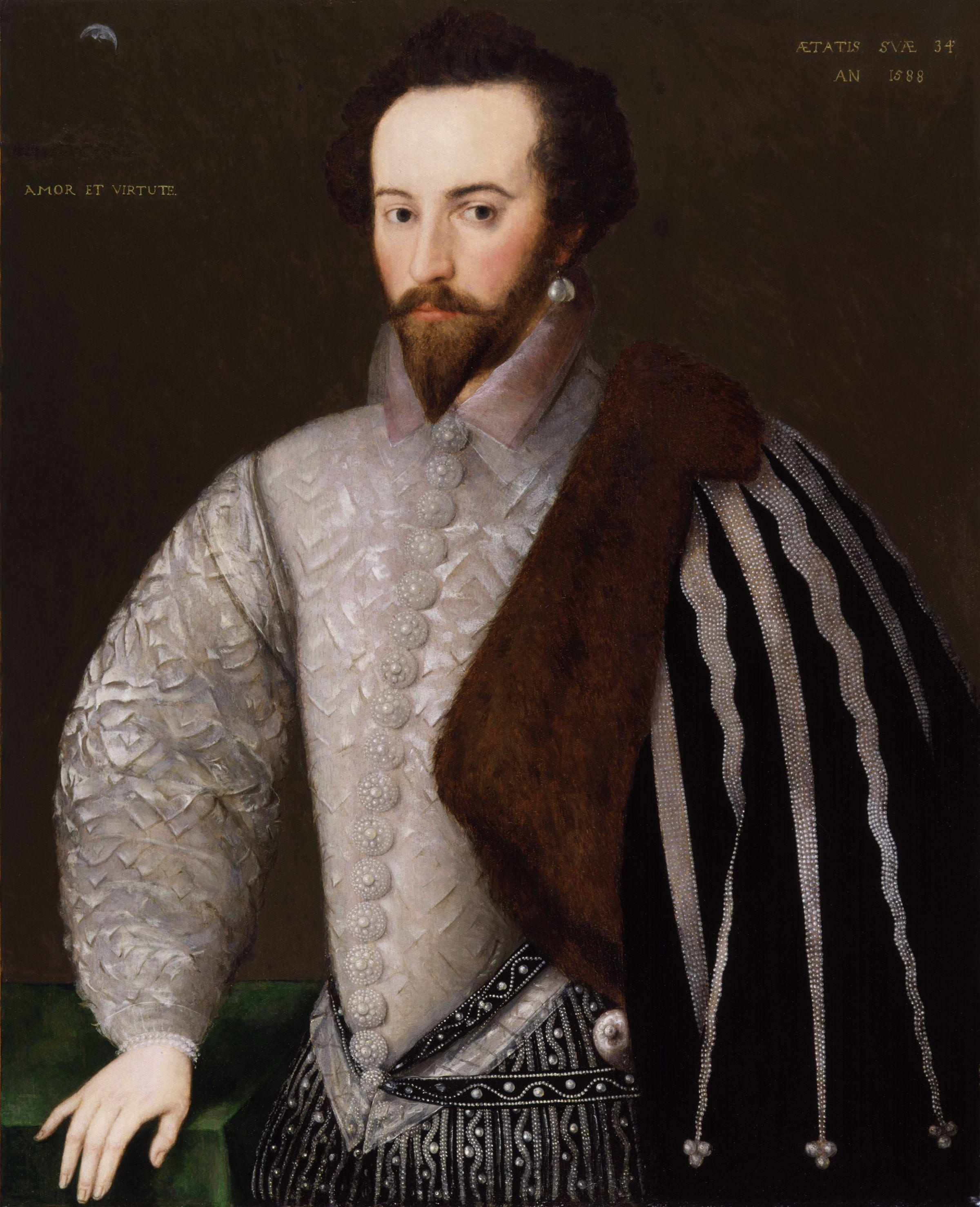 |
| Sir Walter Raleigh (NPG London; image via wikicommons). Note that in this 1588 portrait he was wearing cuffs, not wrist ruffles. If you look into the upper left corner you will see a painting of a moon above the sea, which was an emblem expressing Raleigh's devotion to Elizabeth, the moon goddess Diana who controlled the tides of the sea. |
Regarding the woman shunning the courtier, the Weiss catalogue explains, "Closer examination of this figure in black reveals she has reddish hair, wears a coronet and carries a feather fan. . . . Around
her neck she wears what is perhaps not just a necklace, but possibly a
larger chain denoting an office or order. Could this image be of anyone
else other than the Queen herself?"
Well, I think it's fair to assume the woman is Queen Elizabeth, but of course we can't be certain. This raises the question as to why any restorer would paint the queen out of the picture? Was this the act of somebody purposely trying to devalue a portrait or an act of political censorship? This portrait is a narrative and whoever overpainted this woman destroyed the story being told while devaluing the picture. To me that reeks of a political decision, but that is of course speculation.
 |
| Note: The above photograph was taken of the print hung in my living room |
I've also assumed, without any real evidence, that the portrait was set in the Tower of London, where the contrite nobleman had been imprisoned by Elizabeth I. (Southampton had a portrait of himself painted in the Tower shortly after he was released, so maybe this courtier did the same.) De Vere was held in the Tower in 1581 for siring a bastard. Raleigh was thrown in the Tower for the first time in 1591 for getting married without permission. So which courtier is depicted? And when was it painted?
The
identification of the painter as "circle of Gheeraerts" might suggest that the portrait was created as a ploy to regain favor with the queen. Sir Henry Lee
employed Gheeraerts to this same purpose with the Ditchley portrait of Elizabeth I. Sir Roy Strong once noted that Gheeraert's influence on courtly portraits could be seen as early as 1586.
 |
| Emblem upper right: the moon governing the sea (NPG London image via wikicommons). |
Since the portrait in question is privately owned, its identification can best be resolved (if at all) via costume dating. Is the peascod doublet with padded bishop-style sleeves sans wings plus tilted French linen figure-of-eight collar 1581 or 1590?
When I wrote Mark Weiss regarding the portrait, he was kind enough to correct me on a few points. He also mentioned that he was unaware that wrist ruffs went out of style in the early 1580's (and wisely cautioned me that fashion cut-off points were not absolute). Mr. Weiss further stated he would inquire with the costume expert Susan North at the V&A regarding cuffs. I emailed him back an excerpt from a letter already written by Susan North on that subject of wrist ruffles to Barbara Burris (regarding another mystery portrait) that stated in no uncertain terms that ruffles went out of fashion in the 1580's:
"I would agree that the dress does not appear to date from 1611 . . .
The general shape of the doublet with close fitting sleeves and a waistline
dipping only slightly below its natural place in front corresponds with men’s
dress of the 1570’s . . . Regarding your comments on the wrist ruffs, I agree
that those go out of fashion in the 1580’s."
So, for a while at least, I was left believing it might be de Vere pictured in the Tower c. 1581, but since then two things changed my mind. The first was that I came upon a portrait of Raleigh at the National Portrait Gallery of Ireland wearing very similar type wrist decorations in 1598. (One likely mistake I made was assuming these were wrist ruffles when they were, strictly speaking, extensions of a wavy transparent linen fabric more like a fall collar.) Then I realized how small Raleigh's thumbs were, almost baby thumbs. That same tiny thumb is clearly visible in our mystery portrait. (Many thanks to Graham Appleyard for pointing out the childlike size of the hands in the comments section.) This, to me, was the deciding factor: the tiny thumb pointed at Raleigh.
But, again, that's hardly conclusive evidence.
One other consideration is the buttons on the doublet appear to be decorated with seed pearls, and pearls were a personal symbol for Raleigh that turn up in many of his portraits (see below example). However I haven't been able to confirm these are seed pearls on the buttons. If they are, then that's would seem to settle the matter.
 |
| Sir Walter Raleigh by William Seger 1598 (National Portrait Gallery Ireland, image via wikicommons). In this portrait Raleigh's costume is fabulously decorated with pearls. His wrist extensions are a transparent stached linen similar to those worn by the Courtier in White. |
It's worth noting that the glove visible in the portrait is not a gauntlet. Gauntlets, with their large and decorated wrist coverings, came into fashion in the 1590's. So there's still confusion about when the picture was painted, but I suspect it's Raleigh. The confirmed 1598 portrait of Raleigh shows a courtier much older looking than the unknown courtier in white. With all this in mind, I have to agree with Mark Weiss that this is likely a portrait of Raleigh c. 1592. That date coincides with Raleigh's release from the Tower of London. The portrait might well have been a gift to Elizabeth designed to show repentance and/or gratitude.
 |
| Above: This portrait of Horace Vere by G. Glower from 1594 (image from wikicommons) shows an nearly identical jerkin as that worn by the Courtier in White. There are no wings at the shoulder and the peascod bulge is extended. White was the fashionable color for the later years of Elizabeth's reign. |
See also the post: 20 Essential Questions To Ask When Attempting To Date An Elizabethan Portrait By Costume.
Special thanks to Stella Samaras for setting me straight about the Weiss Gallery write up and also to Graham Appleyard for pointing out the child-like hands of the sitter.
Below:
the controversial Ashbourne Portrait of Shakespeare mid-cleaning 1988 (Folger Shakespeare Library,
left) & Gheeraerts' Courtier in White (private collection, right)


