Showing posts with label Ashbourne portrait. Show all posts

Wednesday, April 26, 2023

A Curious Portrait of a Man Stabbed 57 Times That Might Actually Be A Famous Lost Painting Of William Shakespeare


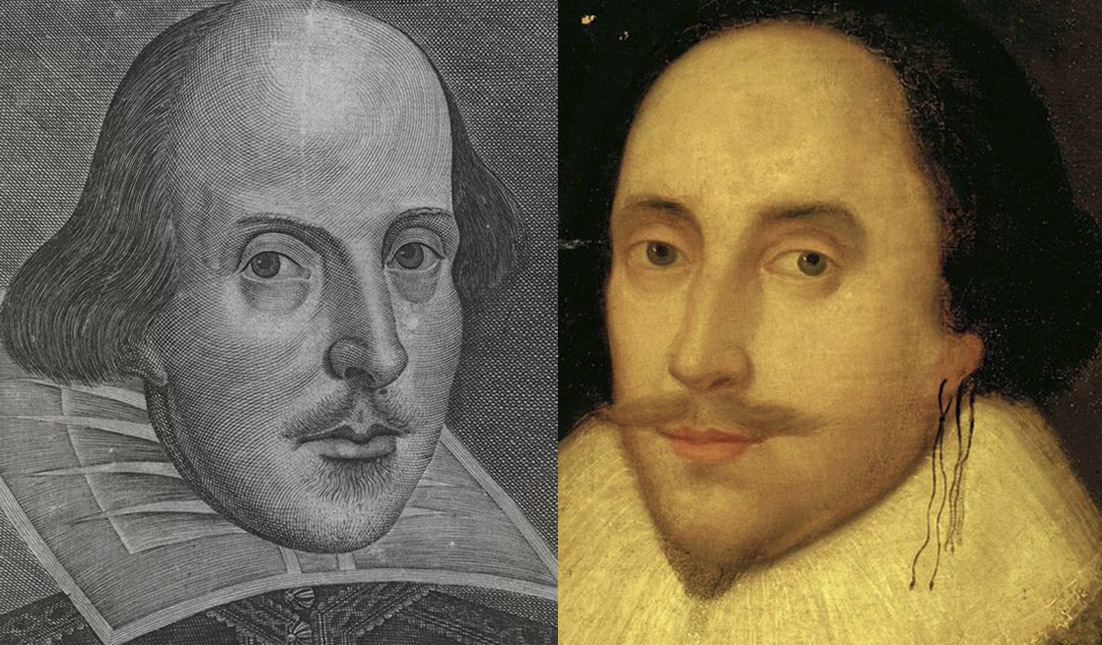
Left: portrait known as David Rizzio (Royal Collection, artist unknown, image from Wikicommons). Right: the Droeshout engraving from Shakespeare's 1623 First Folio (artist unknown, image from Folger Shakespeare Library). The Droeshout engraving is our only authenticated portrait of the poet. For centuries now scholars have been searching for the presumed ad vivum (from life) painted portrait used to create this world famous engraving.

Note 1: there is a very intriguing update at the bottom of this post.

Note 2: all images in this post are being used under fair-use laws. This is an argument regarding the possible mis-identification of a historical portrait that might be connected to William Shakespeare.

If I were allowed to choose one portrait from the Royal Collection to be probed and prodded with spectral technologies this picture would be the one, as I suspect the portrait might actually depict Will Shakespeare painted from life. I'm also curious about its relationship, if any, to the famous Droeshout engraving from Shakespeare's 1623 First Folio and also to Laurence Hilliard's c. 1620 portrait of Shakespeare.  

Over a decade ago I became interested in a portrait kept in London's Royal Collection said to depict the murdered musician David Rizzio. Four things about the portrait caught my eye: (1) the sitter's resemblance to the famous Droeshout engraving, (2) the way the portrait's background contained telltales of having been scrubbed and scamped, (3) the sitter's familiar looking signet ring, (4) the Shakespearean pate clearly visible inside the full head of hair that hinted the sitter might originally have been painted as bald.

Above: portrait of a man known as David Rizzio (Royal Collection, image via wikicommons) Inscribed " 'Dad Rizzo MDLXV.' (1565)". Note the opened pocket on the doublet sleeve exposing bombast, an Elizabethan detail that disappeared from the portrait during its 1974  restoration.

The Royal Collection does not believe this is a portrait of the infamous fiddler David Rizzio. In fact, they believe the portrait to be Jacobean, not Elizabethan, largely due to its costume, and especially the fountain-fall collar. I agree it's probably not Rizzio but suspect the painting might well be Elizabethan. I also suspect the picture might be a carefully overpainted portrait of Will Shakespeare.

There's plenty of intrigue here. For instance, the 1974 restoration of this portrait eliminated one distinct, and likely Elizabethan, feature of the costume: the sleeve pocket (worn open with laces or perhaps point-tied fastenings). The sleeve pocket that disappeared was not consistent with the Royal Collection's current c. 1620 dating of the portrait, and now its gone. 

Above: Sir Thomas Drake 1585-93 by H. Custodis. (Weiss Gallery. Buckland Abbey, Yelverton. Photo source wikicommons.) Note Elizabethan sleeve pocket. Good example of pinking (decorated with small perforations). Fall or falling collar of linen done in two layers the top one transparent. Cuffs at wrists. Skirt of doublet a bit longer. Minimum shoulder wings with attached bishop style sleeves with pocket. Peascod bulge still pronounced. Paneled hose. Hair worn longer. 

I find all that very curious, and I've written the Royal Collection about this disappeared pocket and will update this post when I hear back. (See update below.) I'm curious as to why this sleeve pocket was eliminated and find it unlikely that some later artist would in-paint an extremely rare Elizabethan-style pocket onto a portrait, especially since the blue ground of the painting appears to be exposed, perhaps even scraped, all around the sleeve pocket. Was the portrait x-rayed or IR-ed as part of this 1974 restoration? I'll try to find out. Stayed tuned for the next episode of "The Case of the Disappearing Pocket."  

Above: pocket sleeve with fasteners that are either lacing, or points, or maybe even hook-and-eye. The entire sleeve pocket vanished during the 1974 restoration of the Called Rizzio portrait (Royal Collection; image via wikicommons). Note the bluish ground of the portrait, meaning we are very close to the panel itself. Was this portrait scraped at some point, and, if so, why? There certainly appears to be bombast padding exposed by the open pocket. Bombast might also indicate the portrait to be Elizabethan as such padding when out of style by the turn of the century.

Above: the portrait called Rizzio before and after its latest restoration. (Image on right from Royal Collection Website and used here under Fair Use Law for comparison purposes). Note how a very unique detail, one that may date the sitter's costume as Elizabethan, has been removed (see below to learn more). Why did they removed the sleeve pocket?

Antonia Graser's 1994 book Mary, Queen of Scots described David Rizzio as ugly, short, and hunchbacked, so it's fair to wonder if this handsome jack is Mr. Rizzio. Misleading inscriptions are fairly common, after all. 

It's worth remembering that Rizzio was hideously murdered--stabbed 57 times--when his rumored lover, Mary, Queen of Scots, was six-month's pregnant. Mary's husband Lord Darnley believed, or claimed to believe, that his wife had been impregnated by Rizzio. Mary's subsequent son, possibly the bastard love-child of a rank fiddler, would grow up to become Great Britain's King James I, so the stakes are high on this portrait, and Rizzio's possible intersections with the Stewart clan have been largely repressed. Having fiddler blood instead of royal blood makes for an impressive dynastic scandal.

Above: Called David Rizzio (Royal Collection; image via wikicommons) & stipple engraving of Rizzio (NPG; image via wikicommons). The original print of the engraving states it was copied from a portrait of Rizzio painted in 1562 by an unknown artist "in the possession of H. C. Jennings, Esq." Click here to view the recently restored version of the Called Rizzio portrait currently on the Royal Collection website.

The Royal Collection website makes no mention of the sitter's signet ring when discussing the costume, but it's odd for a musician to wear such a ring. If this is actually a portrait of Rizzio, perhaps the ring can be explained by Rizzio's quick rise from being a bass singer in Mary's court to being installed as her Secretary to France. The matrix or face of the ring appears a bit off-center to me. I'll return to the signet ring later in the update below.

Another enigma about this portrait is that its sitter appears to have originally been painted as bald. Obviously no artist would paint a sitter bald and then add hair later; yet we can see clear evidence of the sitter's pate lurking behind the hair. 

Above: detail reveals what appears to be a bald pate that was later overpainted with hair (Royal Collection, image via wikicommons). The black hair resembling a dyed comb-over is especially odd since the darker hair is depicted on the lighter side of the portrait in regard to the change of color along the background.
Above: the Marshall portrait of Shakespeare (left, Folger Shakespeare Library), Called David Rizzio (center, Royal Collection, image from Wikicommons) and the Droeshout engraving (right, Folger Shakespeare Library).

 
Above: side by side comparison between the Droeshout engraving (reversed) from First Folio show shows eerily similarly lined-up bald pates. The eyes also match up well. Note that engraving were often reversed images of painted portraits; therefore we don't know if the Droeshout engraving is reversed or not.

The background of the portrait appears to my eye heavily scamped in the areas likely to have inscriptions (and yes in the update below the Royal Collection confirms the portrait's background is heavily overpainted but apparently they made no effort to remove this overpaint when retouching the portrait's sleeve pocket).

As to this fountain-style fall collar, said to be Jacobean, it also shows up in the history of bard portraits in the miniature of Shakespeare attributed to Laurence Hilliard. Once again we see a strong physical resemblance between the two sitters. Whoever this unknown jack is, he greatly resembles Laurence Hilliard's William Shakespeare.

Left: copy of the Laurence Hilliard (c. 1620) miniature of Shakespeare by TW Harland  (left, National Portrait Gallery, London). Right: portrait called David Rizzio (Royal Collection). See any resemblance?  

Finally, for the benefit of our Oxfordian readers, here is a comparison of the Rizzio portrait with Edward de Vere, the 17th Earl of Oxford, who was considered an excellent musician and played multiple instruments. Many authorship skeptics believe de Vere to be the true author of Shakespeare's plays. To this I will only add that the violin originated in the early to mid 16th century in Italy and migrated from Italy to England.

Above left: the Welbeck portrait of Edward de Vere (Welbeck Abbey, image from wikicommons). Above center: Called David Rizzio (Royal Collection, image from wikicommons). Above right: c. 1987 post-cleaning photo of the controversial Ashbourne portrait (Folger Shakespeare Library, right).
Above: hand with signet ring from the Ashbourne portrait (left, Folger Shakespeare Library) & hand with signet ring from Called Rizzio (Royal Collection).

Oxfordians have been convinced for decades, and with good reason, that the Ashbourne portrait had its Elizabethan collar overpainted in order to misidentify the sitter Edward de Vere as a haberdasher named Hamersley. Could this inscribed Rizzio portrait actually depict the young Edward de Vere with his violin? Or is this instead a Jacobean portrait, which would mean its sitter is neither de Vere or Rizzio?

A big clue to the identity of sitter might lie in the signet ring, and it would be interesting to probe this ring with spectral technologies. After all, the whole purpose of signet rings is to identify the sitter's family. . .

So, lots of red flags here. And lots of reason to x-ray, or infra-red, or use whatever occult technologies have cooked up of late to get under the paint. Expect some updates to this posts.

Update
I have now received a number of emails from the Royal Collection about their called-Rizzio portrait. Perhaps the most important reveal is that all the conservation notes from the portrait's 1974 restoration (its only restoration of note) have been, well, um, lost. (This is almost invariably the case with Shakespeare candidate portraits btw.) The sleeve pocket was presumably removed, I learned, because it had been added to the portrait, but there's no mention in the email of how that was determined or if x-rays or IRs were even employed. One email implied the sleeve might have been added to make the portrait appear Elizabethan, though it's unclear why anyone would want to forge a portrait to depict David Rizzio. 

Also the emails from the Royal Collection makes it clear that I was correct about the background of the portrait being overpainted. The Rizzio inscription was also added to the portrait at a later date. Apparently the doublet is not leather, though it certainly looks like leather to me. A letter in the portrait's file once described the portrait as a "problem picture." I would agree.  

Below are the emails I received from the Royal Collection. I've highlighted certain passages in bold print. For example, I highlighted the passage in one email in which, within the same paragraph, I was informed that sleeve pockets never existed, and then I was told that maybe the sleeve pocket was added to make the portrait appear Elizabethan. If sleeve pockets didn't exist, then how could one have been added to make a portrait appear Elizabethan?

Also note I immediately responded to that email by sending them a photograph of an Elizabethan portrait with a sleeve pocket (see below portrait of Horace Vere). 

As you read these emails, ask yourself why the Royal Collection has not explored this "problem portrait" with x-rays or infrared light etc. After all, they admit it's extensively overpainted. Obviously somebody went a lot of trouble to misidentify the sitter. Why not learn the portrait's true history? I just don't understand the lack of curiosity in certain collections. And let's bear in mind there's a signet ring here that the Royal Collection knows has been overpainted to deceive us, and yet they've made no effort to test that ring to see its original signifying matrix that will tell us who this person is. Why? What is the Royal Collection they afraid of?

Dear Mr Durkee,

Thank you for your e-mail regarding the Portrait of a Man known as David Rizzio in the Royal Collection (RCIN 401172). The image that you saw on our website (now no longer visible) dates from 1971. It was taken prior to conservation, which I understand took place in 1974 and appears to have been overseen by the Scottish National Portrait Gallery (SNPG). According to a letter of 1988, in our files, correspondence with the conservator who worked on the painting and the SNPG are missing. I suspect that it was during the conservation that the pocket sleeve and lacing were removed presumably because they were identified as later overpainting. 

The painting is due to be published in a revision of Oliver Millar’s Tudor, Stuart and Early Georgian Pictures, 1963 (although it was not included in the first edition). It is thought that the background of the painting has been extensively overpainted. The inscription (which gives the date of the portrait as 1565) is not original and was presumably added a number of years after the portrait was painted. The costume of the sitter can be dated to c. 1620 on the basis of the falling ruff which is far too large for a portrait of the mid-16th century as well as the shape of the doublet, particularly in terms of the manner in which the shoulder wings project beyond the arms. The style of beard and hair are also much more like the fashions of the 1620s.

Perhaps the overpainted ‘pocket’ in the doublet was an attempt to make it appear more Elizabethan. It may also have been a misinterpretation of the fashion for paned (slit) sleeves on doublets, which were common around 1620. Pockets were never found in this sleeve location. The way in which the fabric of the garment has been painted seems more indicative of wool or silk rather than leather and it would have been known as a doublet not a jerkin as jerkins were sleeveless. 

In a letter from Dr Duncan Thomson, then Assistant Keeper of Art, SNPG, to Robert Snowden, the conservator, he describes it as a ‘problem picture’ and felt it was wrong to call it a picture of Rizzio.

You may be interested to know that there is a mark impressed on the stretcher of the painting from the firm of liners, John Peel (c.1785-1858).

I hope this information is of interest.

My reply to the Royal Collection (below):

Thank you for the helpful reply. I still have a few questions and am sorry to hear the notes on the conservation have been lost. Were any spectral tests done on the portrait prior to its restoration? I'm curious as to how it was decided the pocket was added, especially since it was so unique. And thanks also for confirming the sleeve pocket used lacing--I wasn't positive--and yes that would certainly make it Elizabethan.

I disagree that sleeve pockets were never located in that general area and am attaching a portrait to support my case. I have to say it's awfully strange for somebody to in-paint such a specific and uniquely laced open pocket onto a portrait--I've never once seen a laced pocket depicted as open, so it's hard to believe they copied it there from another portrait. And that appears to be bombast that's exposed by the opened pocket, too, and of course bombast disappeared by the end of the century as the human figure returned to men's fashion following Elizabeth's death. To my mind, the argument that somebody wanted the portrait to depict Rizzio so badly they painted an Elizabethan pocket onto the portrait is as strange as an argument stating a fall collar was overpainted onto the portrait to make it look Jacobean. Neither argument has much logic behind it and with the conservation notes lost--you'd be surprised how often this is the case--I guess we will never know now, which is a shame.

Please do let me know if any x-rays or IRs were taken. Or if there are any alternative routes to learning more about this portrait's conservation--might records exist elsewhere?
Thank you again for the reply and this information,
Lee
 
Above: portrait of Horace Vere, 1594 (image from Wikicommons). Note the pocket sleeve, stuff with bombast, clearly visible in the exact location of the portrait known as David Rizzio. The pocket sleeve was therefore an Elizabethan detail and might well date the portrait known as David Rizzio to c. 1594.

Email reply (below) from the Royal Collection in which my evidence the side pocket was an Elizabethan style goes oddly un-noted as does my argument no painter would have forged this obscure costume detail onto a portrait:

Dear Mr Durkee 

Thank you for your e-mail and apologies for the delay in replying. I have now traced the correspondence and reports on the painting from its time at Stenhouse

Conservation Centre during the 1970s and I am afraid that there are no references to any X rays or technical analysis of the painting. There is also no discussion of the removal of the laced pocket sleeve. There is, however, reference to removal of areas of ‘inpainting’ (later overpainting) in ‘oil colours’ which I presume relates to the pocket.

I can only re-iterate that Dr Duncan Thomson, Assistant Keeper of the Scottish National Portrait Gallery, (who oversaw the conservation) believed that it was wrong to go on calling it a portrait of Rizzio.  He felt the costume of the sitter can be dated to c. 1620 and the style of the portrait are of about the same date.  I am sure you are aware of the almost-half-length engraving by Charles Wilkin (c. 1759-1814), of Rizzio, in a ruff and cap, and playing the lute. The engraving is presumably after a portrait of Rizzio which is now not known, and was published by Robert Triphook in 1814 (British Museum). We believe the violin in our portrait could possibly date from the early eighteenth century, however it appears to be an inauthentic rendering of an instrument of the period.  

Finally, I attach a detail of the pocket sleeve from a photograph taken in 1971, prior to the conservation, and we would welcome any further thoughts that you have.

With kind regards [. . .]

Friday, April 14, 2023

Oxford University, Edward de Vere, and the Stratford Bust: Is This the Smoking Gun of Shakespeare Studies?

Above left: The Welbeck portrait of Edward de Vere, the 17th Earl of Oxford (owned by Welbeck Abbey, image from Wikicommons). Above right: the Hunt or Stratford portrait of Shakespeare (owned by Stratford Birthplace Trust, public domain photograph from 1864).

This post picks up where my book STALKING SHAKESPEARE leaves off following its chapter on why the Hunt portrait of Shakespeare has a strong claim to Shakespeare ad vivum (painted from life) and was quite likely the template portrait used to create the iconic bust of Shakespeare in Trinity Church.

Above: the Stratford bust next to the Hunt portrait of William Shakespeare (both photos from Friswell's 1864 Life Portraits of William Shakespeare). In both likenesses Shakespeare is wearing a red jerkin beneath a black robe. No scholar as ever disputed the connection between the two artworks, but which came first?

STALKING SHAKESPEARE is not an authorship book. It's a memoir about my unruly obsession with identifying unknown courtiers in Elizabethan and Jacobean portraits. But the book does delve into the authorship debate whenever that controversy overlaps my portrait obsession (such as with the infamous Ashbourne portrait of Shakespeare) and I do my best to remain a neutral.

The Hunt portrait of Shakespeare is fascinating beyond measure and plagued with telltales scandals--for example, the portrait was discovered in a Stratford attic in the mid-19th century purposely disguised so as not to resemble Shakespeare; yet when cleaned with solvents the portrait turned out to be the spitting image of the famous town bust. No scholar has ever disputed the intimate connection between the portrait and the bust, which leaves us with two logical scenarios: either the portrait was used to create the bust or the bust was used to create the portrait. 

STALKING SHAKESPEARE takes up the claim by 19th century scholars that the portrait came first and was used to create the bust, and my book also argues the Hunt portrait needs to be tested by its owners at the Stratford Birthplace Trust. Because of their neglect, we don't know how old the portrait is or what lies beneath its overpaint (and we know via multiple expert testimony that the picture was immediately altered after its discovery, although we don't know why or to what degree it was altered). As to its age, the portrait descended from the aristocratic Clopton family collection in Stratford and had been stored in the Hunt family attic for at least a hundred years when it was discovered in 1860.

Now let's return to the famous bust at Trinity Church and ask ourselves whether or not that bust could be a tribute to Edward de Vere, the 17th Earl of Oxford?

We know that the traditional Shakespeare of Stratford (the businessman/actor) was not a college-educated man and that there's no record of him even attending the local grammar school in Stratford. With that in mind, it's interesting that a traditional scholar is now conceding that the Stratford bust (and by extension the Hunt portrait) depicts Shakespeare wearing an Oxford University gown.

Lena Cowen Orlin, a professor at Georgetown University, has made this argument inside the pages of The Guardian that states:

The figure is wearing an Oxford University undergraduate’s gown, and the cushion detail is found in monuments memorialising lives of distinction in its college chapels.

She [Orlin] said the fact that he [Shakespeare] wanted to be memorialised with links to the university – despite never going to university himself – “now suggests some collegial association that we don’t know about”.

I'm not sure Orlin's logic holds up in the second paragraph, but the important point is that Shakespeare was immortalized wearing an Oxford gown when we know--and Orlin concedes this--that the traditional author did not attend Oxford. This is quite the monkey wrench tossed into the traditional narrative.

The first question that arises is why did it take centuries for scholars to figure out Shakespeare was wearing a gown that attached him to Oxford University? I would suggest that confirmation bias played a large role, which might also explain why this revelation came out of an American university instead of one in England such as, well, hmm, Oxford.

Edward de Vere, long rumored to have written the works of Shakespeare, did in fact attend Oxford University (hardly surprising for the 17th Earl of Oxford). Clearly the last thing traditional scholars want to do is connect their iconic bust to that infamous earl they despise.

But there's another type of confirmation bias at work here, I suspect, and this one can be found rooted inside the de Vere authorship camp which seems hellbent on denying any connection between their hidden author (de Vere) and the two most famous likenesses of Shakespeare: the Stratford bust at Trinity Church and the Droeshout engraving from Shakespeare's 1623 First Folio. The de Vereians vehemently want those two iconic likenesses to be red-herring representations of the actor/businessman they believe was used as a mask for the the real Shakespeare.

By contrast I think, within the Oxfordian framework, it begs to be argued that one or both of these two traditional likenesses (the bust and the engraving) were created, as much as possible within imposed limitations, to celebrate Edward de Vere. The physical similarities in the photographic comparison at the top of this post seems to my eye more than coincidental and raise questions that are never going to be answered as long as both camps keep their religious blinders on. 

If I were an Oxfordian, the question I'd be asking right now is: has Shakespeare been hidden from us in plain sight?   

Related links:

https://lostshakespeareportraits.blogspot.com/2019/10/a-curious-portrait-of-man-stabbed-57.html

https://www.theguardian.com/culture/2021/mar/19/shakespeare-grave-effigy-believed-to-be-definitive-likeness 

Note: all photographs in this post are used for identification purposes under Fair Use laws. I apologize for not using a color photograph of the Hunt portrait, but the Stratford Birthplace Trust does not make these available.


Monday, December 23, 2019

The Hampton Court Portrait of Shakespeare: How an Examination of Costume Raises Questions

Above: Gustav II Adolf by unknown artist date unknown (left, Gripsholm Castle) & the Hampton Court portrait (Royal Collection, right). All images in this post are for comparison purpose and fall under Fair Use Law (see bottom of post for details). 

I've always rooted for the Hampton Court portrait of Shakespeare to be legit because I like how boisterous, affable, and regal the sitter appears. About a decade ago, following a series of emails I sent the Royal Collection, the curators there agree to X-ray their picture. I am not allowed to post the X-ray radiograph image they kindly sent me, but trust me when I say there were no smoking guns visible, although the radiograph was greatly obscured in many places due to repairs done upon the portrait's cradle and panel.

From the Royal Collection description of the portrait: "The panel is very coarsely painted and repainted, particularly to the head, to enhance the hoped-for likeness to Shakespeare . . . Tree-ring analysis, undertaken in 2010, revealed that that the oak panels on which the portrait was painted derived from the same tree, which was felled after 1616. This suggests the picture was painted sometime after 1621." 

(Note: according to Seeing Through Paintings (Kirsh & Levenson): "Dendrochronologists can determine the date of the felling of a tree but can say nothing about the time needed for dying a panel . . . art historians factor in the drying time by adding a minimum of 2 to 5 years to the felling date.") 

Acquired in 1834 as a portrait of Shakespeare from Penshurst Palace by the "sailor king" William IV, the picture was tested in 1937 with both x-ray and infra-red light by the photographic expert Charles Wisner Barrell, who later reported in the pages of Scientific American that his IR examination had detected a second collar, likely Elizabethan, hidden beneath the Jacobean fountain-fall collar visible on the portrait. (These spectral results disappeared after Barrell's death.) Barrell cited the hidden collar alongside a theory about an obscured sword of state as evidence the portrait had originally depicted Edward de Vere, the 17th Earl of Oxford, the man Barrell believe wrote the works of Shakespeare. 

Above: Welbeck Abbey portrait of Edward de Vere (left) & the Royal Collection's unknown Hampton Court sitter age 34 according to the inscription (right). 

Below: the Folger's Library's Halliwell Phillipps First Unique Proof of Shakespeare (left) a the Royal Collection's Hampton Court Sitter (right).

The Hampton Court's Jacobean fountain-fall collar was created using a commonly used lead-white pigment that X-rays cannot penetrate, so the hidden collar, if it exists, can only be exposed via IR examination, and indeed the X-ray result I studied with my amateur eye showed no hint of a hidden collar--nor would it. The visible collar is certainly compatible with the Royal Collection's Jacobean dating on the portrait (c. 1620-25) and likely dictated that dating (which was established before they tested the wooden panel in 2010). That said, other aspects of the sitter's costume remain vexing if we approach it as English portrait.

Smitten by confirmation bias, I had coasted along with the theory the portrait might depict Shakespeare for many years until one day I came across a portrait of Gustav the Great, king of Sweden from 1611 to 1632. In almost all his portraits, Gustav  proudly displays his royally protruding belly. Gustav's portraits typically show him belted above the belly, or directly over the belly, thereby making portraits of him a bit easier to identify. The rotund belly has long been associated with regal stature.

Above: Gustav II Adolf, c.1630 by Jacob Heinrich Elbfas (Skokloster Castle, left) & the Hampton Court Portrait of Shakespeare (Royal Collection, London, right). Note how the belt buckles, though of different sizes, are identical in shape and strapped across the upper belly.

Even if you disagree about Gustav II being the sitter of the Hampton Court picture, the many portraits of Gustav supply evidence that the Hampton Court costume is neither Elizabethan nor Jacobean. The costume likely isn't even English. The displayed belly of the Hampton Court lends the illusion of a mid 1590s English-style portrait when bombast stuffing was exposed in melancholy disarray via an unbuttoned peascod-bellied doublet, but I suspect this is not a peascod doublet in the Hampton Court picture; instead the sitter is likely wearing a farthingale-type padding that lends the illusion almost of pregnancy.

Above: Gustav II flaunting the same style vented sleeves present in the Hampton Court Portrait. These sleeves could be unbuttoned to hang behind the back. (Gustav II Adolf, 1594-1632, kung av Sverige - Nationalmuseum - 39108, photo via Wikicommons).
Above: Henry Percy, the "Wizard earl," with bombast bared in pose meant to convey melancholy. Painted by Nicholas Hilliard. Image via wikicommons.    
Above: the bombastic satirist Thomas Nashe shackled by bilboes with doublet undone and bombast displayed c. 1595. Image via wikicommons.

Below are some more comparisons worth pondering.

Above: Gustavus II by Jacob Hoefnagel 1624 (Google Arts Project, left) & the Hampton Court (RC, London, right)

Above: Awesome portrait of Gustav II by Matthaeus Merian the Elder 1631-02 (Google Arts Project, left) & Hampton Court (Royal Collection, right). The portrait on the left was likely painted about four years after the Hampton Court portrait (if we accept the inscribed age of 34 as valid). Note the similar sword hilts and pommels.

Above: Gustav II Adolph date artist and date unknown (Gripsholm Castle, National Museum Sweden) & the Hampton Court portrait (Royal Collection, right)
Above: Gustav II Adolph date and artist unknown (Nationalmuseum, Gripsholm Castle) & the Hampton Court portrait (Royal Collection, right). 
 
Anyone wanting a deeper dive should follow this link to a collection of still-existing costumes once owned by Gustav II, almost all of which reveal the same style jerkin or doublet with longish tapering skirts that come together to form an arrowhead pointing directly to where, decades earlier, we would have found a codpiece. Gustav was also frequently portraited wearing vented sleeves of the type known as hanging sleeves (not to be confused with sham sleeves); this is the same style sleeve found in the Hampton Court picture.

 Below: Costumes of Gustav II displayed in the National Armory in Stockholm. The doublet immediately below is displayed one of the king's rapiers very much resembling the rapier in the Hampton Court picture.
Above: The Hampton Court portrait (Royal Collection, London) displayed beside still existing costumes of Gustav II. Please also note the resemblance of the swords in the two above image.

Anyone interested in Gustav the Great can follow this link to a page featuring an illustrated description of his life. A king who inherited three wars, all of which he fought brilliantly (he's considered one of the greatest military leaders of all time), Gustav is also credited with bringing Sweden into the modern age. He died on the battlefield while leading a charge uphill in the Thirty Days War. If the inscribed age of 34 is correct on the Hampton Court portrait, then it depicts Gustav c. 1628, which would correlate the Royal Collection's dating of the wooden panel. And since Gustav the Great was a Protestant hero, it's almost certain a portrait of him would have existed inside the Protestant stronghold of Penshurst Palace.

So here's to Sweden's Gustav the Great. Though we have lost a poet, we have gained a monarch.

Jokes aside, I don't mean to speak in absolute terms. Obviously this argument is far from over and we won't know the truth until we finally see the IR-test results of the Hampton Court. Will that ever happen? I have no idea.

Note 1: the above argument is abbreviated so as not to overlap too much with my memoir STALKING SHAKESPEARE (Scribner 2023).

Note 2: I often defend Charles Wisner Barrell in my book. I've found him to be reliable and don't mean to disparage him here. I strive very hard to be neutral on the authorship debate whenever it overlaps the portraits rumored to be Shakespeare.

Related links: How To Date Elizabethan Portraits by Costume 

NOTE: ALL IMAGES USED IN THIS POST ARE FOR COMPARISON PURPOSE AND THEREFORE FALL UNDER FAIR USE LAWS
 

Wednesday, May 29, 2019

A Courtier In White Spurned by Queen Elizabeth I: Is he Raleigh or de Vere?

 Detail from A Courtier and His Lady by Circle of Marcus Gheeraerts (private collection). Photograph taken from a print hung in my living room. I've been going back and forth on this portrait for decades now, but I think I've finally concluded, to my satisfaction at least, who the sitter is. See below post for details.

I have a print of this portrait hung in my living room and for decades now have been debating whether the shunned courtier in white, posing before a powerful woman with her back turned to him, is Sir Walter Raleigh or Edward de Vere. I once wrote a blog post arguing it was Raleigh. Then I began to suspect it was de Vere. And now I've reversed my opinion again and believe it's Raleigh. But there are still a lot of unanswered questions regarding this portrait.

I recently learned from Stella Samaras, a reader of this blog, that a catalogue available from Weiss Gallery ("Tudor and Stewart Portraits 1530-1600") written by Mark Weiss, with the assistance of Sir Roy Strong, attributed this portrait not to Robert Peake but to the circle of Marcus Gheeraerts the Younger and dates the picture to c. 1590-1595. As to this date, my first reaction was surprised that the wrist ruffles didn't cause Weiss to date the picture to 1584 or earlier since ruffles were replaced by cuffs around then. But we will get to that discussion in a moment.

The catalogue states the portrait was at some point "dramatically overpainted." The courtier was scamped with a head of dark hair, a beard, and a hat "so that he better resembled Sir Walter Raleigh." Stranger yet, the woman in the background so resembling Elizabeth I (with her back turned significantly to the male courtier) was overpainted out of the portrait entirely. And the inscription "Sir. Walt. Rawleigh" was added to the upper right corner.   

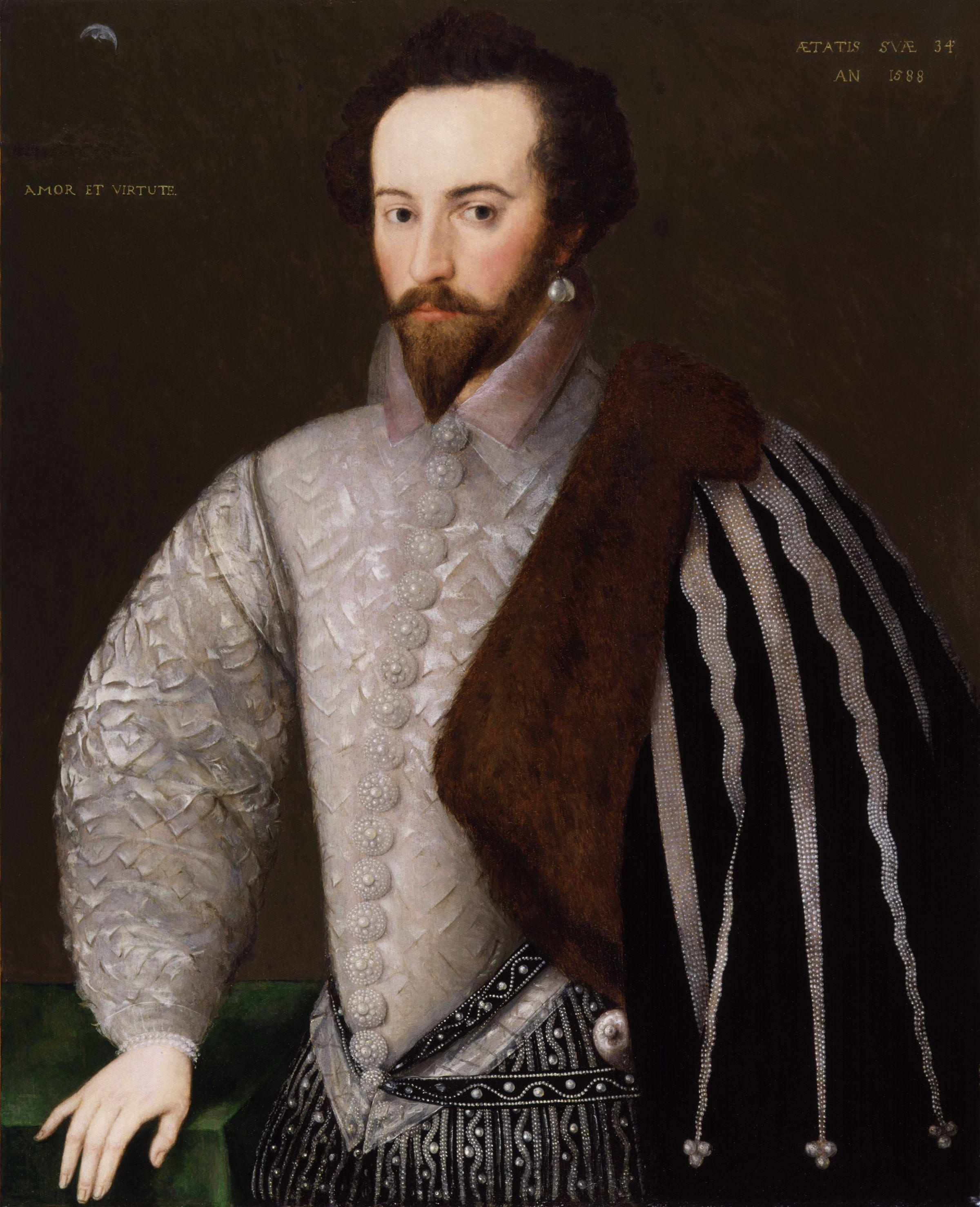
Note that in the portrait of Raleigh below he has cuffs instead of ruffles. The inscription, if accurate, establishes the portrait was painted in 1588, a few years after wrist ruffles went out of style, so the cuffs fit the inscribed date. As does the bombast stuffing in the bishop sleeves, the giant buttons on the doublet, and the Armada perm. This is in fact a textbook 1588 portrait.

https://upload.wikimedia.org/wikipedia/commons/f/f2/Sir_Walter_Ralegh_by_%27H%27_monogrammist.jpg
Sir Walter Raleigh (NPG London; image via wikicommons). Note that in this 1588 portrait he was wearing cuffs, not wrist ruffles. If you look into the upper left corner you will see a painting of a moon above the sea, which was an emblem expressing Raleigh's devotion to Elizabeth, the moon goddess Diana who controlled the tides of the sea.

Regarding the woman shunning the courtier, the Weiss catalogue explains, "Closer examination of this figure in black reveals she has reddish hair, wears a coronet and carries a feather fan. . . . Around her neck she wears what is perhaps not just a necklace, but possibly a larger chain denoting an office or order. Could this image be of anyone else other than the Queen herself?"

Well, I think it's fair to assume the woman is Queen Elizabeth, but of course we can't be certain. This raises the question as to why any restorer would paint the queen out of the picture? Was this the act of somebody purposely trying to devalue a portrait or an act of political censorship? This portrait is a narrative and whoever overpainted this woman destroyed the story being told while devaluing the picture. To me that reeks of a political decision, but that is of course speculation. 

Note: The above photograph was taken of the print hung in my living room
I've also assumed, without any real evidence, that the portrait was set in the Tower of London, where the contrite nobleman had been imprisoned by Elizabeth I. (Southampton had a portrait of himself painted in the Tower shortly after he was released, so maybe this courtier did the same.) De Vere was held in the Tower in 1581 for siring a bastard. Raleigh was thrown in the Tower for the first time in 1591 for getting married without permission. So which courtier is depicted? And when was it painted?    

The identification of the painter as "circle of Gheeraerts" might suggest that the portrait was created as a ploy to regain favor with the queen. Sir Henry Lee employed Gheeraerts to this same purpose with the Ditchley portrait of Elizabeth I. Sir Roy Strong once noted that Gheeraert's influence on courtly portraits could be seen as early as 1586.   
Emblem upper right: the moon governing the sea (NPG London image via wikicommons).
Since the portrait in question is privately owned, its identification can best be resolved (if at all) via costume dating. Is the peascod doublet with padded bishop-style sleeves sans wings plus tilted French linen figure-of-eight collar 1581 or 1590?

When I wrote Mark Weiss regarding the portrait, he was kind enough to correct me on a few points. He also mentioned that he was unaware that wrist ruffs went out of style in the early 1580's (and wisely cautioned me that fashion cut-off points were not absolute). Mr. Weiss further stated he would inquire with the costume expert Susan North at the V&A regarding cuffs. I emailed him back an excerpt from a letter already written by Susan North on that subject of wrist ruffles to Barbara Burris (regarding another mystery portrait) that stated in no uncertain terms that ruffles went out of fashion in the 1580's:
"I would agree that the dress does not appear to date from 1611 . . . The general shape of the doublet with close fitting sleeves and a waistline dipping only slightly below its natural place in front corresponds with men’s dress of the 1570’s . . . Regarding your comments on the wrist ruffs, I agree that those go out of fashion in the 1580’s."

So, for a while at least, I was left believing it might be de Vere pictured in the Tower c. 1581, but since then two things changed my mind. The first was that I came upon a portrait of Raleigh at the National Portrait Gallery of Ireland wearing very similar type wrist decorations in 1598.  (One likely mistake I made was assuming these were wrist ruffles when they were, strictly speaking, extensions of a wavy transparent linen fabric more like a fall collar.) Then I realized how small Raleigh's thumbs were, almost baby thumbs. That same tiny thumb is clearly visible in our mystery portrait. (Many thanks to Graham Appleyard for pointing out the childlike size of the hands in the comments section.) This, to me, was the deciding factor: the tiny thumb pointed at Raleigh.

 But, again, that's hardly conclusive evidence.

One other consideration is the buttons on the doublet appear to be decorated with seed pearls, and pearls were a personal symbol for Raleigh that turn up in many of his portraits (see below example). However I haven't been able to confirm these are seed pearls on the buttons. If they are, then that's would seem to settle the matter.

Sir Walter Raleigh by William Seger 1598 (National Portrait Gallery Ireland, image via wikicommons). In this portrait Raleigh's costume is fabulously decorated with pearls. His wrist extensions are a transparent stached linen similar to those worn by the Courtier in White.
It's worth noting that the glove visible in the portrait is not a gauntlet. Gauntlets, with their large and decorated wrist coverings, came into fashion in the 1590's. So there's still confusion about when the picture was painted, but I suspect it's Raleigh. The confirmed 1598 portrait of Raleigh shows a courtier much older looking than the unknown courtier in white. With all this in mind, I have to agree with Mark Weiss that this is likely a portrait of Raleigh c. 1592. That date coincides with Raleigh's release from the Tower of London. The portrait might well have been a gift to Elizabeth designed to show repentance and/or gratitude.
Above: This portrait of Horace Vere by G. Glower from 1594 (image from wikicommons) shows an nearly identical jerkin as that worn by the Courtier in White. There are no wings at the shoulder and the peascod bulge is extended. White was the fashionable color for the later years of Elizabeth's reign.
See also the post: 20 Essential Questions To Ask When Attempting To Date An Elizabethan Portrait By Costume
 

Special thanks to Stella Samaras for setting me straight about the Weiss Gallery write up and also to Graham Appleyard for pointing out the child-like hands of the sitter. 

Below: the controversial Ashbourne Portrait of Shakespeare mid-cleaning 1988 (Folger Shakespeare Library, left) & Gheeraerts' Courtier in White (private collection, right)
Above: ruffles instead of cuffs plus a glove lacking a gauntlet

The Folger Shakespeare Library owns the Ashbourne portraits seen above.